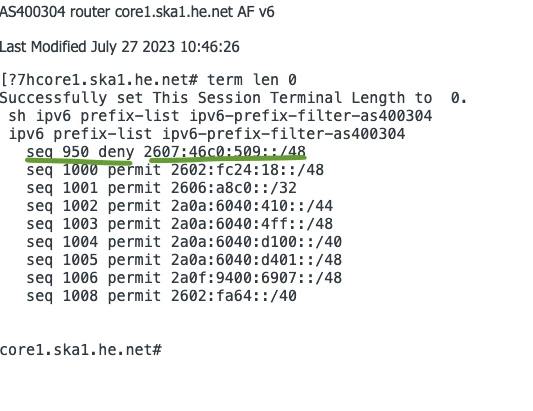
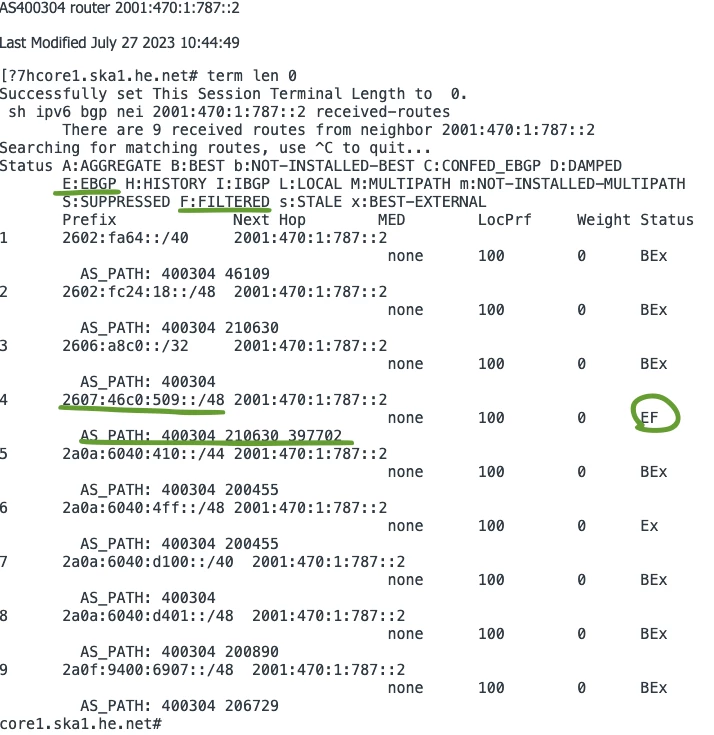
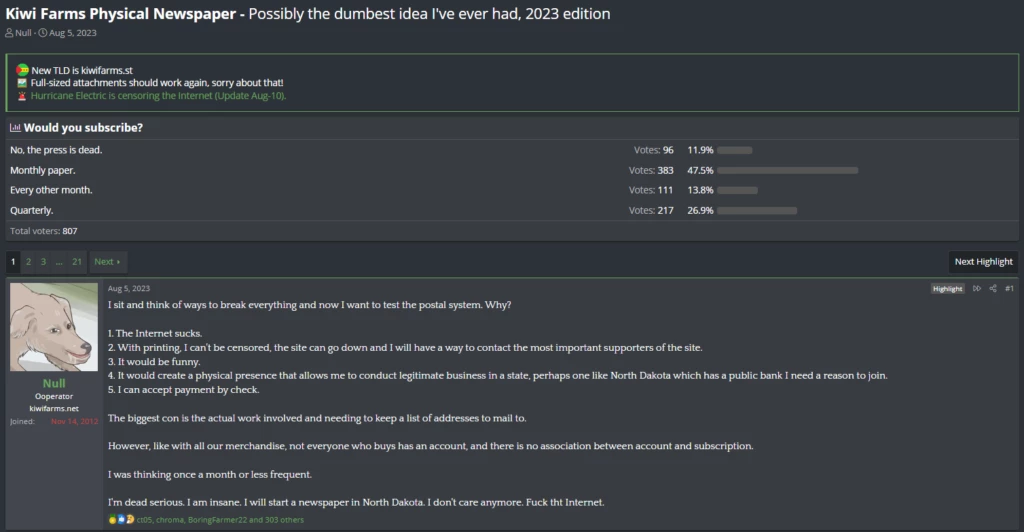
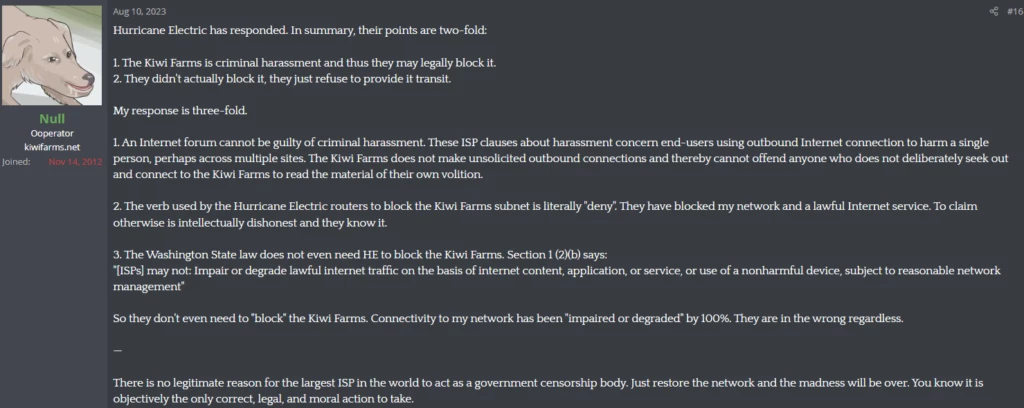
米国政府は、Kiwi Farms による継続的なストーカー行為、嫌がらせ、個人情報の暴露の被害者を援助すべき時です。そうすれば、他の関係者全員が下劣で危険なウェブサイトで作成され、ホストされているコンテンツを管理していない場合、Hurricane Electric のような企業が援助する必要がなくなります。
(ii) ストーカーが相手に恐怖を与えたり、脅迫したり、嫌がらせをしたりする意図がなかったとしても、相手が恐怖、脅迫、または嫌がらせを受けていることを知っている、または合理的に知るべきであること。
(2)(a) It is not a defense to the crime of stalking under subsection (1)(c)(i) of this section that the stalker was not given actual notice that the person did not want the stalker to contact or follow the person; and
(b) It is not a defense to the crime of stalking under subsection (1)(c)(ii) of this section that the stalker did not intend to frighten, intimidate, or harass the person.
(3) It shall be a defense to the crime of stalking that the defendant is a licensed private investigator acting within the capacity of his or her license as provided by chapter 18.165 RCW.
(4) Attempts to contact or follow the person after being given actual notice that the person does not want to be contacted or followed constitutes prima facie evidence that the stalker intends to intimidate or harass the person. “Contact” includes, in addition to any other form of contact or communication, the sending of an electronic communication to the person.
(5)(a) Except as provided in (b) of this subsection, a person who stalks another person is guilty of a gross misdemeanor.
(b) A person who stalks another is guilty of a class B felony if any of the following applies: (i) The stalker has previously been convicted in this state or any other state of any crime of harassment, as defined in RCW 9A.46.060 , of the same victim or members of the victim's family or household or any person specifically named in a protective order; (ii) the stalking violates any protective order protecting the person being stalked; (iii) the stalker has previously been convicted of a gross misdemeanor or felony stalking offense under this section for stalking another person; (iv) the stalker was armed with a deadly weapon, as defined in RCW 9.94A.825 , while stalking the person; (v)(A) the stalker's victim is or was a law enforcement officer; judge; juror; attorney; victim advocate; legislator; community corrections' officer; an employee, contract staff person, or volunteer of a correctional agency; court employee, court clerk, or courthouse facilitator; or an employee of the child protective, child welfare, or adult protective services division within the department of social and health services; and (B) the stalker stalked the victim to retaliate against the victim for an act the victim performed during the course of official duties or to influence the victim's performance of official duties; or (vi) the stalker's victim is a current, former, or prospective witness in an adjudicative proceeding, and the stalker stalked the victim to retaliate against the victim as a result of the victim's testimony or potential testimony.
(6) As used in this section:
(a) “Correctional agency” means a person working for the department of natural resources in a correctional setting or any state, county, or municipally operated agency with the authority to direct the release of a person serving a sentence or term of confinement and includes but is not limited to the department of corrections, the indeterminate sentence review board, and the department of social and health services.
(b) “Course of conduct” means a pattern of conduct composed of a series of acts over a period of time, however short, evidencing a continuity of purpose. “Course of conduct” includes, in addition to any other form of communication, contact, or conduct, the sending of an electronic communication, but does not include constitutionally protected free speech. Constitutionally protected activity is not included within the meaning of “course of conduct.”
(c) “Follows” means deliberately maintaining visual or physical proximity to a specific person over a period of time. A finding that the alleged stalker repeatedly and deliberately appears at the person's home, school, place of employment, business, or any other location to maintain visual or physical proximity to the person is sufficient to find that the alleged stalker follows the person. It is not necessary to establish that the alleged stalker follows the person while in transit from one location to another.
(d) “Harasses” means a knowing and willful course of conduct directed at a specific person which seriously alarms, annoys, harasses, or is detrimental to such person, and which serves no legitimate or lawful purpose. The course of conduct shall be such as would cause a reasonable person to suffer substantial emotional distress, and shall actually cause substantial emotional distress to the petitioner, or when the course of conduct would cause a reasonable parent to fear for the well-being of his or her child.
(e) “Protective order” means any temporary or permanent court order prohibiting or limiting violence against, harassment of, contact or communication with, or physical proximity to another person.
(f) “Repeatedly” means on two or more separate occasions.
(a) Without lawful authority, the person knowingly threatens:
(i) To cause bodily injury immediately or in the future to the person threatened or to any other person; or
(ii) To cause physical damage to the property of a person other than the actor; or
(iii) To subject the person threatened or any other person to physical confinement or restraint; or
(iv) Maliciously to do any other act which is intended to substantially harm the person threatened or another with respect to his or her physical or mental health or safety; and
(b) The person by words or conduct places the person threatened in reasonable fear that the threat will be carried out. “Words or conduct” includes, in addition to any other form of communication or conduct, the sending of an electronic communication.
(2)(a) Except as provided in (b) of this subsection, a person who harasses another is guilty of a gross misdemeanor.
(b) A person who harasses another is guilty of a class C felony if any of the following apply: (i) The person has previously been convicted in this or any other state of any crime of harassment, as defined in RCW 9A.46.060 , of the same victim or members of the victim's family or household or any person specifically named in a no-contact or no-harassment order; (ii) the person harasses another person under subsection (1)(a)(i) of this section by threatening to kill the person threatened or any other person; (iii) the person harasses a criminal justice participant who is performing his or her official duties at the time the threat is made; or (iv) the person harasses a criminal justice participant because of an action taken or decision made by the criminal justice participant during the performance of his or her official duties. For the purposes of (b)(iii) and (iv) of this subsection, the fear from the threat must be a fear that a reasonable criminal justice participant would have under all the circumstances. Threatening words do not constitute harassment if it is apparent to the criminal justice participant that the person does not have the present and future ability to carry out the threat.
(3) Any criminal justice participant who is a target for threats or harassment prohibited under subsection (2)(b)(iii) or (iv) of this section, and any family members residing with him or her, shall be eligible for the address confidentiality program created under RCW 40.24.030 .
(4) For purposes of this section, a criminal justice participant includes any (a) federal, state, or local law enforcement agency employee; (b) federal, state, or local prosecuting attorney or deputy prosecuting attorney; (c) staff member of any adult corrections institution or local adult detention facility; (d) staff member of any juvenile corrections institution or local juvenile detention facility; (e) community corrections officer, probation, or parole officer; (f) member of the indeterminate sentence review board; (g) advocate from a crime victim/witness program; or (h) defense attorney.
(5) The penalties provided in this section for harassment do not preclude the victim from seeking any other remedy otherwise available under law.
Anyways, as always, the Kiwi Farms saga continues to deliver, and we'll continue covering it here on WebSite .
それではまた次回。
PS You know things are bad when a very Libertarian-leaning organization, EFF, is saying the government needs to intervene.